

Forging Patience in an Impatient World
September 17, 2026
The holiday season has a way of arriving all at once. One week it’s pumpkins and cooler mornings, and the next the calendar is crowded with gatherings, deadlines, gift lists, and travel plans. For many of us, the season promises warmth and togetherness, yet we reach the end of it feeling more tired than connected.
What if this year we did it differently? What if, before the rush begins, we made a quiet decision to center the season on people instead of tasks, on presence instead of presents, and on community instead of our never-ending to-do lists?
At Big Voices Rise, we talk a lot about speaking up and being heard. But a voice is only as meaningful as the community that surrounds it. The holidays offer a natural moment to turn that voice outward and to say “I’m here,” or ask, “what do you need?” and give back in ways that matter.
The Season of Too Much and Not Enough
The holidays can be a strange mix of abundance and absence. Tables are full, stores are glowing, and music is everywhere. At the same time, many people are navigating loneliness, grief, financial strain, or the simple exhaustion of keeping up appearances.
That contrast is worth acknowledging. Someone in your neighborhood may be dreading a quiet house; a coworker may be stretching a tight budget to cover a season that feels expensive. A neighbor may have lost someone this year and doesn’t know how to say so.
Community is the answer to many of these quiet struggles—not because it fixes everything, but because being noticed is a form of care.
When someone knows they’re part of something, even something small, the weight of the season feels lighter.
Community Is a Practice, Not a Place
When we hear the word community, we often imagine something large and organized: a church, a nonprofit, or a neighborhood association, and those are wonderful. But community is also much simpler than that, it’s the people you cross paths with and the web of small relationships that make a place feel like home.
Like any relationship, community takes tending. It isn’t something you find ready-made. It’s something you build through repeated, ordinary acts such as saying hello on the sidewalk, learning the name of the person who runs your favorite coffee shop, checking in on the neighbor who lives alone, or showing up to the school fundraiser even when you’re tired.
The good news is that this means anyone can begin to build community at any time. It doesn’t require an invitation or a title, just willingness.
Giving Back Gives Back
There’s a reason people often say they got more than they gave when they volunteer. Contributing to something larger than ourselves tends to lift our own spirits, reduce feelings of isolation, and give our days a sense of purpose.
That doesn’t make generosity selfish. It simply means the exchange runs in both directions. When you hand someone a meal, you also receive a conversation. When you help sort donations, you leave with new friends. When you give your time, you get a window into how others live, and your own life gains perspective.
As you think about giving this season, remember that the healthiest giving happens between equals, as neighbors, with mutual respect.
Ways to Give That Aren’t Monetary
Financial donations matter, and many organizations depend on year-end giving. If you’re able to contribute, that’s a meaningful gift, though not always sustainable for yourself. It’s important to note that money is only one example of generosity, and it isn’t available to everyone. Here are other ways to give back:
● Give your time. Food banks, shelters, community kitchens, and toy drives often need extra
hands during the holidays, and some are short on volunteers well into the new year. Even a
single afternoon helps.
● Give your skills. Are you good with spreadsheets, cooking, writing, tutoring, repairs, or design?
Offer what you already know. A small nonprofit may value your expertise more than you’d guess.
● Give your presence. Visit an older neighbor, invite a coworker who’s far from family to join your
table, sit with someone who’s grieving. Presence is a gift that needs no wrapping; it just requires
you to show up.
● Give your voice. Advocate for a cause you care about. Share an organization’s call for help. Speak
up for someone who isn’t being heard. This is where big voices do their best work.
● Give your stuff, thoughtfully. Clear out the coats, blankets, books, and household items you no
longer need. Check first with local organizations about what they can actually use, so your
generosity helps rather than burdens.
● Give your attention. Listen without fixing and without hurrying. Sometimes the most generous
thing you can do is let someone finish their story.
Start Close to Home
One of the easiest ways to feel overwhelmed by giving is to look at everything that needs doing. The needs of the world are enormous, and that can make our own contribution feel small.
Try shrinking the circle and think local. Start with your street, your building, your workplace, your school, your place of worship, your local library. Ask yourself: who is within a few minutes of me who might need a hand or a friend?
Local giving has a special kind of power. You can see results, follow up, and build relationships that outlast the season, and you remind yourself that community isn’t an abstract idea, it’s the people sharing your zip code
A few ideas to try:
● Organize a neighborhood coat or canned-food collection.
● Host a simple potluck for people who might otherwise spend the day alone.
● Offer to shovel, rake, or carry groceries for a neighbor who could use it.
● Write cards for residents at a nearby care facility.
● Ask your local school or library how you can support families this winter.
Give with Consideration
The best giving is thoughtful giving. It respects the dignity of the person on the receiving end. That means asking what people actually need rather than assuming. It means offering without making someone feel pitied. And it means being mindful that people don’t want to be someone’s holiday project.
A few gentle guidelines can help:
● Ask someone before you act. “Would it help if I brought dinner this week?” lets someone say yes
or no on their own terms.
● Make it easy to accept by framing it as an invitation, not a favor: “We made too much food.
Would you want to come help us eat it?”
● Keep it private when it matters, because not every act of kindness needs an audience, and giving
shouldn’t be performative.
● Follow through with your promises and hold yourself accountable. A promise to help in January
matters just as much as one in December.
Consideration and generosity are close cousins, both begin with paying attention to the person in front of you.
If You’re the One Who Needs Support
It’s worth saying plainly: if this season feels heavy for you, you are part of the community too, and you deserve to be held by it.
Receiving is its own kind of courage. Asking for help, accepting an invitation, or telling someone “this year is hard” can feel vulnerable, but it also gives others the chance to show up, which is something most people want. In a truly beneficial and supporting community, getting someone to help care for you is not a burden, but a gift.
If you’re not sure where to turn, start small. Reach out to one person. Attend one gathering. Walk into one community space. Connection often begins with a single step toward it.
A Simple Plan for the Season
If you’d like a gentle roadmap, here’s one that fits into a busy calendar:
- Before Thanksgiving: Pick one local cause or group and learn how you can support it. Put a date
on your calendar. - Early December: Reach out to someone who might be alone this season with a call, a card, or an
invitation. - Mid-December: Give something meaningful, whether time, skills, or resources, and invite a
friend or family member to join you. - Between the holidays: Check in on people again; sometimes the days after the festivities can be
the loneliest. - January and beyond: Keep one small commitment going. A monthly volunteer shift, a standing
coffee with a neighbor, a recurring donation. Community doesn’t end when the decorations
come down.
The Gift That Keeps Giving
Years from now, you probably won’t remember most of the gifts you gave or received this season. You’re
more likely to remember the neighbor who dropped off soup when you were sick, the stranger who
stopped to help, or the afternoon you spent serving alongside people you’d never met.
Those moments are what have the power to turn a collection of individuals into a community. When you
use your big voice to bring others together this holiday season, remember that you’re curating a
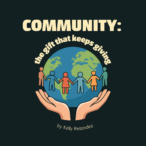
collective belonging. Community is the gift that keeps giving